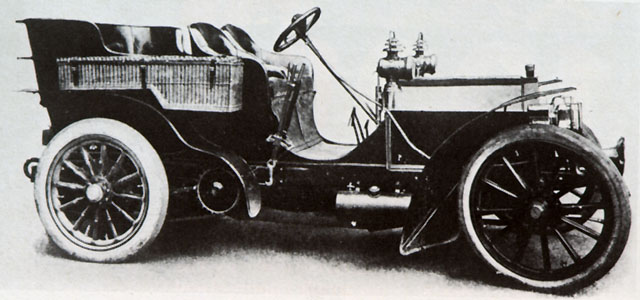
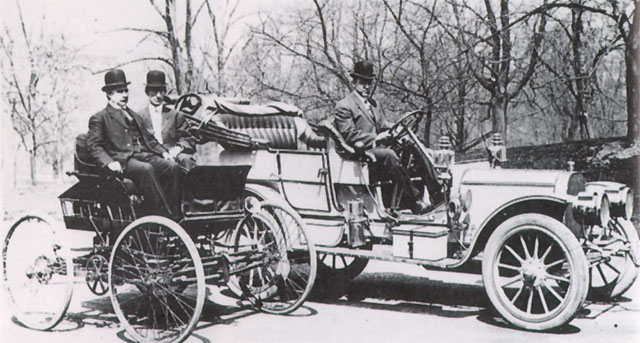
What was the first car in the world

Several Italians recorded designs for wind driven vehicles. The first was Guido da Vigevano in 1335. It was a windmill type drive to gears and thus to wheels. Vaturio designed a similar vehicle which was also never built. Later Leonardo da Vinci designed a clockwork driven tricycle with tiller steering and a differential mechanism between the rear wheels.

A Catholic priest named Father Ferdinand Verbiest has been said to have built a steam powered vehicle for the Chinese Emperor Chien Lung in about 1678. There is no information about the vehicle, only the event. Since Thomas Newcomen didn't build his first steam engine until 1712 we can guess that this was possibly a model vehicle powered by a mechanism like Hero's steam engine, a spinning wheel with jets on the periphery. Newcomen's engine had a cylinder and a piston and was the first of this kind, and it used steam as a condensing agent to form a vacuum and with an overhead walking beam, pull on a rod to lift water. It was an enormous thing and was strictly stationary. The steam was not under pressure, just an open boiler piped to the cylinder. It used the same vacuum principle that Thomas Savery had patented to lift water directly with the vacuum, which would have limited his pump to less than 32 feet of lift. Newcomen's lift would have only been limited by the length of the rod and the strength of the valve at the bottom. Somehow Newcomen was not able to separate his invention from that of Savery and had to pay for Savery's rights. In 1765 James Watt developed the first pressurized steam engine which proved to be much more efficient and compact that the Newcomen engine.

The first vehicle to move under its own power for which there is a record was designed by Nicholas Joseph Cugnot and constructed by M. Brezin in 1769. A replica of this vehicle is on display at theConservatoire des Arts et Metiers, in Paris. I believe that the Smithsonian Museum in Washington D. C. also has a large (half size ?) scale model. A second unit was built in 1770 which weighed 8000 pounds and had a top speed on 2 miles per hour and on the cobble stone streets of Paris this was probably as fast as anyone wanted to go it. The picture shows the first model on its first drive around Paris were it hit and knocked down a stone wall. It also had a tendency to tip over frontward unless it was counterweighted with a canon in the rear. the purpose of the vehicle was to haul canons around town.

The early steam powered vehicles were so heavy that they were only practical on a perfectly flat surface as strong as iron. A road thus made out of iron rails became the norm for the next hundred and twenty five years. The vehicles got bigger and heavier and more powerful and as such they were eventually capable of pulling a train of many cars filled with freight and passengers.
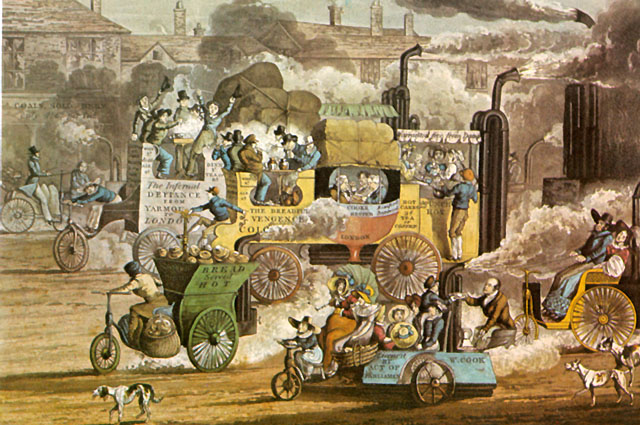
As the picture at the right shows, many attempts were being made in England by the 1830's to develop a practical vehicle that didn't need rails. A series of accidents and propaganda from the established railroads caused a flurry of restrictive legislation to be passed and the development of the automobile bypassed England. Several commercial vehicles were built but they were more like trains without tracks.

The development of the internal combustion engine had to wait until a fuel was available to combust internally. Gunpowder was tried but didn't work out. Gunpowder carburetors are still hard to find. The first gas really did use gas. They used coal gas generated by heating coal in a pressure vessel or boiler. A Frenchman named Etienne Lenoir patented the first practical gas engine in Paris in 1860 and drove a car based on the design from Paris to Joinville in 1862. His one-half horse power engine had a bore of 5 inches and a 24 inch stroke. It was big and heavy and turned 100 rpm. Lenoir died broke in 1900.

Lenoir had a separate mechanism to compress the gas before combustion. In 1862, Alphonse Bear de Rochas figured out how to compress the gas in the same cylinder in which it was to burn, which is the way we still do it. This process of bringing the gas into the cylinder, compressing it, combusting the compressed mixture, then exhausting it is know as the Otto cycle, or four cycle engine. Lenoir claimed to have run the car on benzene and his drawings show an electric spark ignition. If so, then his vehicle was the first to run on petroleum based fuel, or petrol, or what we call gas, short for gasoline.

Siegfried Marcus, of Mecklenburg, built a can in 1868 and showed one at the Vienna Exhibition of 1873. His later car was called the Strassenwagen had about 3/4 horse power at 500 rpm. It ran on crude wooden wheels with iron rims and stopped by pressing wooden blocks against the iron rims, but it had a clutch, a differential and a magneto ignition. One of the four cars which Marcus built is in the Vienna Technical Museum and can still be driven under its own power.

In 1876, Nokolaus Otto patented the Otto cycle engine, de Rochas had neglected to do so, and this later became the basis for Daimler and Benz breaking the Otto patent by claiming prior art from de Rochas.

The picture to the left, taken in 1885, is of Gottllieb Daimler's workshop in Bad Cannstatt where he built the wooden motorcycle shown. Daimler's son Paul rode this motorcycle from Cannstatt to Unterturkheim and back on November 10, 1885. Daimler used a hot tube ignition system to get his engine speed up to 1000 rpm

The previous August, Karl Benz had already driven his light, tubular framed tricycle around the Neckar valley, only 60 miles from where Daimler lived and worked. They never met. Frau Berta Benz took Karl's car one night and made the first long car trip to see her mother, traveling 62 miles from Mannheim to Pforzheim in 1888.

Also in August 1888, William Steinway, owner of Steinway & Sons piano factory, talked to Daimler about US manufacturing right and by September had a deal. By 1891 the Daimler Motor Company, owned by Steinway, was producing petrol engines for tramway cars, carriages, quadricycles, fire engines and boats in a plant in Hartford, CT.

Steam cars had been built in America since before the Civil War but the early one were like miniature locomotives. In 1871, Dr. J. W. Carhart, professor of physics at Wisconsin State University, and the J. I. Case Company built a working steam car. It was practical enough to inspire the State of Wisconsin to offer a $10,000 prize to the winner of a 200 mile race in 1878.>

The 200 mile race had seven entries, or which two showed up for the race. One car was sponsored by the city of Green Bay and the other by the city of Oshkosh. The Green Bay car was the fastest but broke down and the Oshkosh car finished with an average speed of 6 mph.

From this time until the end of the century, nearly every community in America had a mad scientist working on a steam car. Many old news papers tell stories about the trials and failures of these would be inventors.

By 1890 Ransom E. Olds had built his second steam powered car, pictured at left. One was sold to a buyer in India, but the ship it was on was lost at sea.
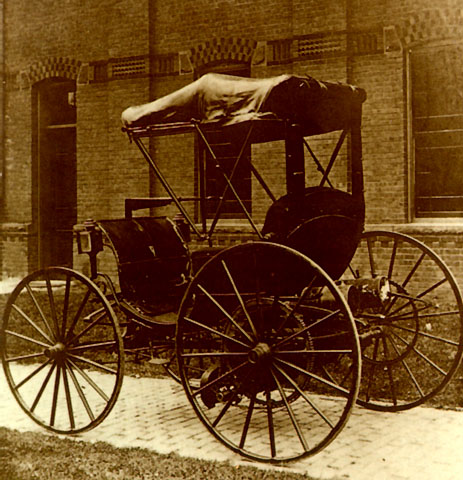
Running by February, 1893 and ready for road trials by September, 1893 the car built by Charles and Frank Duryea, brothers, was the first gasoline powered car in America. The first run on public roads was made on September 21, 1893 in Springfield, MA. They had purchased a used horse drawn buggy for $70 and installed a 4 HP, single cylinder gasoline engine. The car (buggy) had a friction transmission, spray carburetor and low tension ignition. It must not have run very well because Frank didn't drive it again until November 10 when it was reported by the Springfield Morning Union newspaper. This car was put into storage in 1894 and stayed there until 1920 when it was rescued by Inglis M. Uppercu and presented to the United States National Museum.

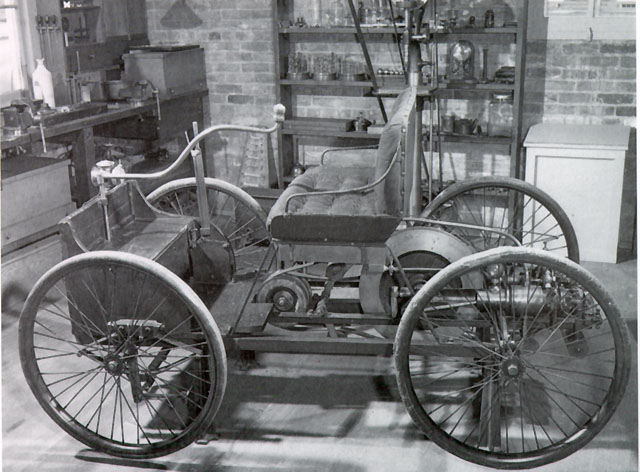
Henry Ford had an engine running by 1893 but it was 1896 before he built his first car. By the end of the year Ford had sold his first car, which he called a Quadracycle, for $200 and used the money to build another one. With the financial backing of the Mayor of Detroit, William C. Maybury and other wealthy Detroiters, Ford formed the Detroit Automobile Company in 1899. A few prototypes were built but no production cars were ever made by this company. It was dissolved in January 1901. Ford would not offer a car for sale until 1903.

The first closed circuit automobile race held at Narragansett Park, Rhode Island, in September 1896. All four cars to the left are Duryeas, on the right is a Morris & Salom Electrobat. Thirteen Duryeas of the same design were produced in 1896, making it the first production car.

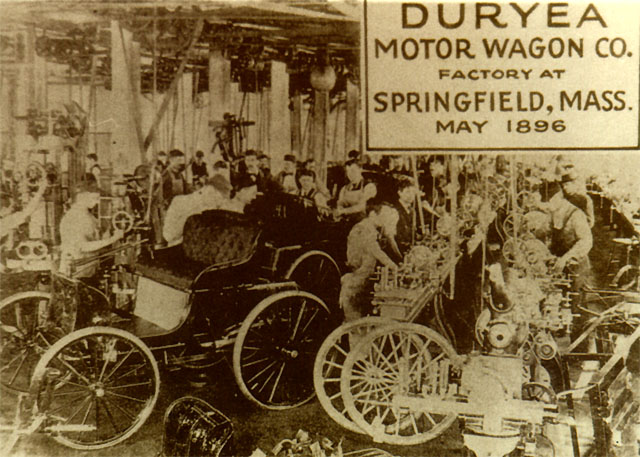
At left is pictured the factory with produced the 13 Duryeas. In 1898 the brothers went their separate ways and the Duryea Motor Wagon Company was closed. Charles, who was born in 1861 and was eight years older than Frank had taken advantage of Frank in publicity and patents. Frank went out on his own and eventually joined with Stevens Arms and Tool Company to form the Stevens-Duryea Company which was sold to Westinghouse in 1915. Charles tried to produce some of his own hare-brained ideas with various companies until 1916. Thereafter he limited himself to writing technical book and articles. He died in 1938. Frank got a half a million dollars for the Westinghouse deal and lived in comfort until his death in 1967, just seven months from his 98th birthday.

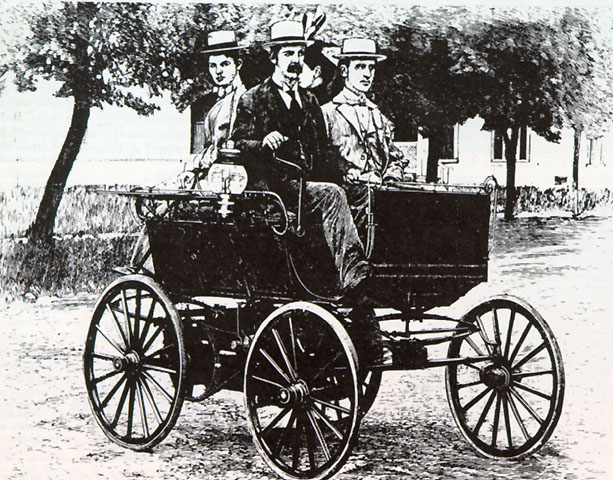
In this engraving Ransom Eli Olds is at the tiller of his first petrol powered car. Riding beside him is Frank G. Clark, who built the body and in the back are their wives. This car was running by 1896 but production of the Olds Motor Vehicle Company of Detroit did not begin until 1899. After an early failure with luxury vehicles they established the first really successful production with the classic Curved Dash Oldsmobile.

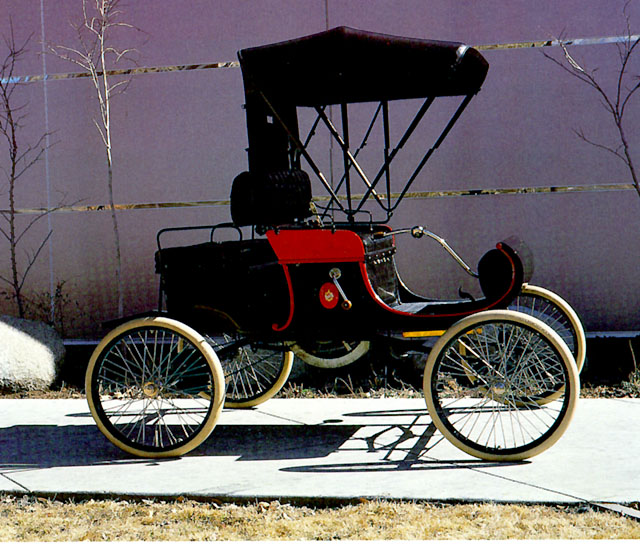
The Curved Dash Oldsmobile had a single cylinder engine, tiller steering and chain drive. It sold for $650. In 1901 600 were sold and the next years were 1902 - 2,500, 1903 - 4,000, 1904 - 5,000. In August 1904 Ransom Olds left the company to form Reo (for Ransom Eli Olds). Ransom E. Olds was the first mass producer of gasoline powered automobiles in the United States, even though Duryea was the first auto manufacturer with their 13 cars.

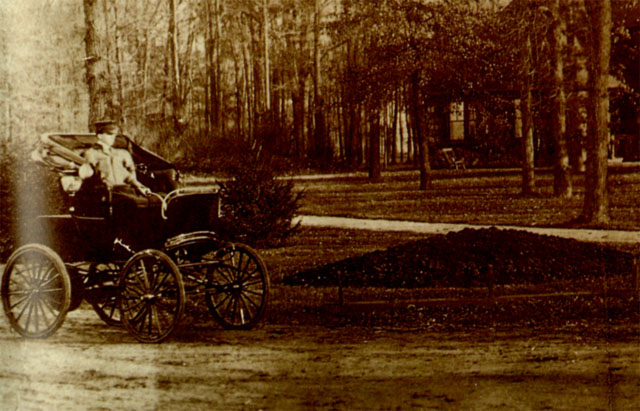
Ransom Olds produced a small number of electric cars around the turn of the century. Little is known about them and none survive. The picture at left is the only known picture of one of these rare cars. It was taken at was taken at Belle Island Park, Michigan. In 1899 and 1900, electrics outsold all other type of cars and the most popular electric was the Columbia built by Colonel Albert Augustus Pope, owner of American Bicycle Company.
an interesting footnote to the Olds electric.
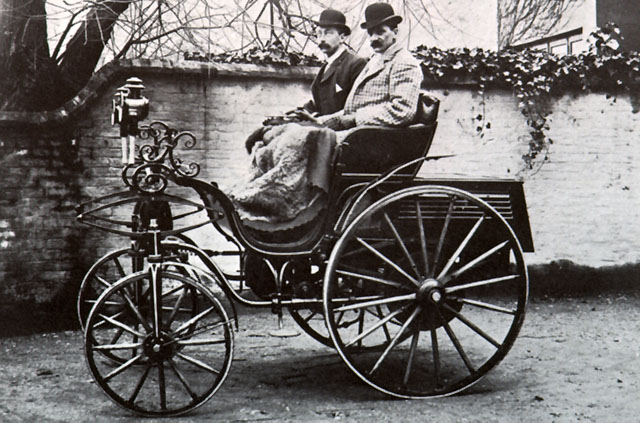
J. A. Koosen and H. Lawson in a 1895 Lutzmann. This is typical of American design in the mid 1890's. It was truly a horseless carriage. Tiller steering, engine under the floorboards, very high center of gravity, not designed for road travel. Imagine climbing into one of these and trying to drive across town and around a few corners. Kind of scary, huh?

This Daimler of 1899 was owned by Lionel Rothchild. The European design is much advanced of the American designs of the same time. Gottlieb Daimler took part in the London-to-Brighton run in 1896 but died in 1900 at the age of 66 without ever meeting Benz. His German engines powered the automobile industries of Britain and France.

The 1908 Haynes in the back ground shows the rapid development of the petrol powered car when compared to the 1894 model in the foreground. Consider the present difference between a 1998 Tarus and the 14 year old 1984 Tarus. Some difference. Old man Haynes claimed to have build the 1894 car in 1893 but had no proof.

The Rolls Royce Silver Ghost of 1906 was a six cylinder car that stayed in production until 1925. It represented the best engineering and technology available at the time and these cars still run smoothly and silently today. This period marked the end of the beginning of the automobile.


How The Car Changed The County, Town by Town

In 1903, in Winfield, Kansas Mr. H. T. Trice is seen standing in from of the first car in town. Acutally it was more like a truck and was used to haul customers out to see land. The railroadsbrought potential customers to town and Mr. Trice picked them up at the depot and took them out to his new developments.

Steam power was widely used in the 1880's and 1890's on the farms of America. Cowley County had its share of these behemoths and had a large group of people with the ability to use, and the skill to fix and repair them. The smaller, less expensive automobile, with an internal combustion engine provided a new avenue of interest that was much more personal than the steam engine with its team of attendants.

Mr. Martin Baden of Winfield, Kansas and his new eight-cylinder Cadillac roadster. This car was especially built for Mr. Baden, and was equipped with all modern appliances. Driving an automobile required a high degree to technical dexterity, mechanical skill, special clothing including hat, gloves, duster coat, goggles and boots. Tires were notoriously unreliable and changing one was an excruciating experience. Fuel was a problem, since gasoline was in short supply. Mr. Baden became interested enough to become a self-taught geologist and eventually discover major oil deposits in Cowley County, Kansas, and surrounding area.

The drivers of the day were an adventurous lot, going out in every kind of weather, unprotected by an enclosed body, or even a convertible top. Everyone in town knew who owned what car and the cars were soon to become each individuals token of identity. Notice the guy at the far right fixing his flat time. The dirt roads were a challenge in any weather. By 1910 Winfield paved the downtown streets with brick, horses were no longer welcome. The mule drawn trolleys were upgraded to electric streetcars.

By 1915 racing had become a passion all over the United States. A typical local race track was at the Cowley County Fairgrounds in Winfield, Kansas. The local obsession with horse racing, started by the earliest settlers in 1870, turned to the new technology of auto racing. Local farm boys who were familiar with motors and equipment used their talents on cars and motorcycles to go faster than anyone in the county.

The horse racing facilities were quickly converted to the new, faster, more dangerous, and thus more exciting, motor racing. See Bob Lawrence's Home Page for new sections on both Auto Racing and Motorcycle Racing in Cowley County, Kansas

Eventually the automobile change the face of small town America. The town gentry bought cars, albiet fashoned to match their station in life. In Winfield, Kansas, Main Street went from a gathering place for people and horses and wagons to a parking place for the ubiquitous automobile. The Trolley Cars were displaced to make room for more cars. The brick streets were covered with asphalt to provide a smoother ride for the automobile. The old fire maps of Winfield show the inexorable spread of the automobile and all of the supporting businesses. Filling stations, auto dealers, battery stations, oil depots all grew and expanded to displace to older technologies of the day. R. B. Sandford's Winfield Carriage Works appears on the fire-map of Block 127 in 1918. But on the same spot on Block 127 in 1925 it has been replaced by a Battery Station and an Auto Storage facility.

Midway through the century, cars had become a central feature of life for young people. The cars owned by the students of Winfield High School in the fifties are typical of every where in America at that time. It was mobility, status, challenge, and social freedom. It certainly hurt our football team at the time. A typical excuse for not playing on the football team was that a student had to work to earn money to pay for their car. When asked why they needed a car, the answer was invariably: to get to work!

After a century of the automobile, we can begin to assess the effects of long term transport by internal combustion. Nearly every aspect of our lives has developed around this technology. Only now, are we seeing new digital communications technologies, of the internet and beyond, that may eventually displace some of the functions of the automobile and replace our current problems with a new set that you, our grandchildren, will be charged with solving. Ask your grandparents about their first car. I'm sure you will get to hear a great story.

read more “What was the first car in the world”

What was the first web browser?

was first released.
You can learn more about the original "WorldWideWeb" browser from Tim Berners-Lee himself.

Since WorldWideWeb had a graphical user interface (GUI), it could be called a graphical web browser. However, it did not display web pages with graphics embedded in them That did not happen until the arrival of NCSA Mosaic 2.0.

The first graphical web browser to become truly popular and capture the imagination of the public was NCSA Mosaic. Developed by Marc Andreessen, Jamie Zawinski and others who later went on to create the Netscape browser, NCSA Mosaic was the first to be available for Microsoft Windows, the Macintosh, and the Unix X Window System, which made it possible to bring the web to the average user. The first version appeared in March 1993. The "inline images," such as the boutell.com logo at the top of this page, that are an integral part of almost every web page today were introduced by NCSA Mosaic 2.0, in January of 1994. Mosaic 2.0 also introduced forms.

Netscape is the browser that introduced most all of the remaining major features that define a web browser as we know it. The first version of Netscape appeared in October 1994 under the code name "Mozilla." Netscape 1.0's early beta versions introduced the "progressive rendering" of pages and images, meaning that the page begins to appear and the text can be read even before all of the text and/or images have been completely downloaded. Version 1.1, in March 1995, introduced HTML tables, which are now used in the vast majority of web pages to provide page layout. Version 2.0, in October 1995, introduced frames, Java applets, and JavaScript. Version 2.0 was the last version of Netscape to introduce a major feature of the web as we know it today; later versions improved reliability and stability and introduced features that did not catch on as standards for all browsers. In 1998, Netscape decided to release their browser source code as open source software, and the Mozilla project began.

Microsoft Internet Explorer is by far the most common web browser in use as of this writing. Internet Explorer 1.0, released in August 1995, broke no important new ground in a way that became part of a future standard. Later versions of Internet Explorer quickly caught up; Internet Explorer 3.0 was very close to Netscape 2.0's feature set. In July 1996, Internet Explorer 3.0 beta introduced the first useful implementation of cascading style sheets, which allow better control of the exact appearance of web pages. In April 1997, Internet Explorer 4.0 introduced the first quality implementation of the Document Object Model (DOM), which allows Javascript to modify the appearance and content of a web page after it has been loaded.

read more “What was the first web browser?”

Fascinating and astonishing facts of life & nature

ASTONISHING FACTS

Longest english word
Praetertranssubstantiationalistically --> has 37 letters.

Book without letter 'e'
Gadfy, written by Earnest Wright in 1939 is a 50,000+ word book, which doesn't contain a single word with ' e' in it

Word without vowel
Rhythm

Organ of body which has no sensation when cut
Brain

Only animal & reptile which sheds tear while eating
Crocodile

No of Alphabets, which SOUND AS WORDS:
B Bee
C Sea
G Zee
I Eye
Q Queue
R Are
S Yes
T Tea
U You
Y Why

  _____ 

WHAT ARE THEY ?

Q) If we say 'MUMMY', they come together & go apart when we say 'DADDY'?
(A)
LIPS

(Q) What goes up & never comes down?
(A)
AGE

(Q) Patches over patches but no stitches?
(A)
CABBAGE

(Q) What is that we cannot see, but is always before you?
(A)
FUTURE

(Q) What goes up & down a hill, but never moves?
(A)
ROAD

(Q) You can never wet it?
(A)
SHADOW

(Q) What belongs to to You, but used by your friends more often you do?
(A)
YOUR NAME

  _____ 

FASCINATING ANIMALS, BIRDS, TREES

SNAILS have 14175 teeth laid along 135 rows on their tounge.

A BUTTERFLY has 12,000 eyes.

DOLPHINS sleep with 1 eye open.

A BLUE WHALE can eat as much as 3 tonnes of food everyday, but at the same time can live without food for 6 months.

The EARTH has over 12,00,000 species of animals, 3,00,000 species of plants & 1,00,000 other species.

The fierce
DINOSAUR was TRYNOSAURS which has sixty long & sharp teeth, used to attack & eat other dinosaurs.

DIMETRODON was a mammal like REPTILE with a snail on its back. This acted as a radiator to cool the body of the animal.

CASSOWARY is one of the dangerous BIRD, that can kill a man or animal by tearing off with its dagger like claw.

The SWAN has over 25,000 feathers in its body.

OSTRICH eats pebbles to help digestion by grinding up the ingested food.

POLAR BEAR can look clumsy & slow but during chase on ice, can reach 25 miles / hr of speed.

KIWIS are the only birds, which hunt by sense of smell.

ELEPHANT teeth can weigh as much as 9 pounds.

OWL is the only bird, which can rotate its head to 270 degrees.

  _____ 

IN 24 HOURS AVERAGE HUMAN

IN 24 HOURS AVERAGE HUMAN:

HEART
beats 1,03,689 times.

LUNGS respire 23,045 times.

BLOOD flows 16,80,000 miles.

NAILS grow 0.00007 inches

HAIR grows 0.01715 inches

Take 2.9 pounds
WATER (including all liquids)

Take of 3.25 pounds
FOOD.

Breathe 438 cubic feet
AIR.

Lose 85.60,
BODY TEMPERATURE.

Produce 1.43 pints
SWEAT.

Speak 4,800
WORDS.

During
SLEEP move 25.4 times

read more “Fascinating and astonishing facts of life & nature”

World’s Largest Animals


Largest animal


Image credit: Wikimedia Commons
Blue whale is the largest animal of all times. The recorded weight of this animal was 190 tonnes with the length of 30m.

Largest living land animal


Image credit: Greenexpander
Largest living land animal is African Bush elephant which has an average weight of 100 kg at the time of birth. The largest elephant recorded was a male having the weight of 13.5 tons and a length of 10.6 m (from trunk to tail) with a shoulder height of 4.2 m.

Largest living land carnivore


Image credit: Nationalgeographic
Polar bear and brown bear are the largest living land carnivores having the weight of 1 ton and height of 3m.

Largest reptile


Image credit: Nationalgeographic
The largest living reptile is saltwater crocodile with the length of 5 m. The largest recorded crocodile had a weight of 1,900 kg and 6.3 m length.

Tallest living land animal


Image credit: Wikimedia Commons
Having 5.8 m height giraffe is considered as the tallest living animal on the land. Its weight is approximately 2,000 kg.

Largest living bird


Image credit: Nationalgeographic
Ostrich is the largest living bird having a height of 2.7 m and a weight of 156 kg.

Largest amphibian


Image credit: Sciencedaily
Chinese giant salamander is the largest living amphibian having a weight of 64 kg and 1.83 m length.

Largest fish


Image credit: Whale-shark.org
Whale shark is the largest living fish having a length of 13.6 m and 22,000 kg weight.

Largest invertebrate


Image credit: Extremescience
Colossal Squid is the largest invertebrate which attains the maximum size of 14 m long. The largest recorded size of colossal squid was measured 10 m long with a weight of 494 kg.

Heaviest insect


Image credit: Britannica
Goliath beetle is the heaviest beetle having a weight of 115 g and a length of 11.5 cm.
read more “World’s Largest Animals”

What was the first animal in the world


Answer is Sponges.
Sponges are animals of the phylum Porifera (pronounced /pɒˈrɪfərə/). Their bodies consist of jelly-like mesohyl sandwiched between two thin layers of cells. While all animals have unspecialized cells that can transform into specialized cells, sponges are unique in having some specialized cells that can transform into other types, often migrating between the main cell layers and the mesohyl in the process. Sponges do not have nervous, digestive or circulatory systems. Instead most rely on maintaining a constant water flow through their bodies to obtain food and oxygen and to remove wastes, and the shapes of their bodies are adapted to maximize the efficiency of the water flow. All are sessile aquatic animals and, although there are freshwater species, the great majority are marine (salt water) species, ranging from tidal zones to depths exceeding 8,800 metres (5.5 mi). While most of the approximately 5,000 known species feed on bacteria and other food particles in the water, some host photosynthesizing micro-organisms as endosymbionts and these alliances often produce more food and oxygen than they consume. A few species of sponge that live in food-poor environments have become carnivores that prey mainly on small crustaceans.[1]
Sponges are known for regenerating from fragments that are broken off, although this only works if the fragments include the right types of cells. A few species reproduce by budding. When conditions deteriorate, for example as temperatures drop, many freshwater species and a few marine ones produce gemmules, "survival pods" of unspecialized cells that remain dormant until conditions improve and then either form completely new sponges or re-colonize the skeletons of their parents. However most sponges use sexual reproduction, releasing sperm cells into the water. In viviparous species the cells that capture most of the adults' food capture the sperm cells but, instead of digesting them, transport them to ova in the parent's mesohyl. The fertilized eggs begin development within the parent and the larvae are released to swim off in search of places to settle. In oviparous species both sperm and egg cells are released into the water and fertilisation and development take place outside the parent's bodies.
Sponges use various materials to reinforce their mesohyl and in some cases to produce skeletons, and this forms the main basis for classifying sponges. Calcareous sponges produce spicules made of calcium carbonate. Demosponges reinforce the mesohyl with fibers of a special form of collagen called spongin, most also produce spicules of silica, and a few secrete massive external frameworks of calcium carbonate. Although glass sponges also produce spicules made of silica, their bodies mainly consist of syncytia that in some ways behave like many cells sharing a single external membrane, and in others like individual cells with multiple nuclei. Probably because of their variety of construction methods, demosponges constitute about 90% of all known species, including all freshwater ones, and have the widest range of habitats. Calcareous sponges are restricted to relatively shallow marine waters where production of calcium carbonate is easiest. The fragile glass sponges are restricted to polar regions and the ocean depths where predators are rare, and their feeding systems very efficiently harvest what little food is available. Fossils of all of these types have been found in rocks dated from 580 to 523 million years ago. In addition Archaeocyathids, whose fossils are common in rocks from 530 million years ago but not after 490 million years ago, are now regarded as a type of sponge.
It is generally thought that sponges' closest single-celled relatives are choanoflagellates, which strongly resemble the cells that sponges use to drive their water flow systems and capture most of their food. It is also generally agreed that sponges do not form a monophyletic group, in other words do not include all and only the descendants of a common ancestor, because it is thought that Eumetazoa (more complex animals) are descendants of a sub-group of sponges. However it is uncertain which group of sponges is closest to Eumetazoa, as both calcareous sponges and a sub-group of demosponges called Homoscleromorpha have been nominated by different researchers. In addition a study in 2008 suggested that the earliest animals may have been similar to modern comb jellies. Since comb jellies are considerably more complex than sponges, this would imply that sponges had mobile ancestors and greatly simplified their bodies as they adapted to a sessile filter feeding lifestyle. Chancelloriids, sessile, bag-like organisms whose fossils are found only in rocks from the Cambrian period, increase the uncertainty as it has been suggested that they were sponges but also that their external spines resemble the "chain mail" of the slug-like Halkieriids.
The few species of demosponge that have entirely soft fibrous skeletons with no hard elements have been used by humans over thousands of years for several purposes, including as padding and as cleaning tools. However by the 1950s these had been over-fished so heavily that the industry almost collapsed, and most sponge-like materials are now synthetic. Sponges and their microscopic endosymbionts are now being researched as possible sources of medicines for treating a wide range of diseases. Dolphins have been observed using sponges as tools while foraging.


read more “What was the first animal in the world”

What was the first rocket launched into space


The first rocket which could fly high enough to get into space was the V2 missile which was first launched by Germany in 1942. The first rocket which actually launched something into space was used to launch Sputnik, the first satellite, on October 4, 1957. The rocket that launched Sputnik was a R-7 ICBM rocket.
read more “What was the first rocket launched into space”

what was the world's 1st computer


history of computers
"Who invented the computer?" is not a question with a simple answer. The real answer is that many inventors contributed to the history of computers and that a computer is a complex piece of machinery made up of many parts, each of which can be considered a separate invention.
This series covers many of the major milestones in computer history (but not all of them) with a concentration on the history of personal home computers.

Computer History
Year/Enter
Computer History
Inventors/Inventions
Computer History
Description of Event
1936
Konrad Zuse - Z1 ComputerFirst freely programmable computer.
1942
John Atanasoff & Clifford Berry
ABC Computer
Who was first in the computing biz is not always as easy as ABC.
1944
Howard Aiken & Grace Hopper
Harvard Mark I Computer
The Harvard Mark 1 computer.
1946
John Presper Eckert & John W. Mauchly
ENIAC 1 Computer
20,000 vacuum tubes later...
1948
Frederic Williams & Tom Kilburn
Manchester Baby Computer & The Williams Tube
Baby and the Williams Tube turn on the memories.
1947/48
John Bardeen, Walter Brattain & Wiliam Shockley
The Transistor
No, a transistor is not a computer, but this invention greatly affected the history of computers.
1951
John Presper Eckert & John W. Mauchly
UNIVAC Computer
First commercial computer & able to pick presidential winners.
1953
International Business Machines
IBM 701 EDPM Computer
IBM enters into 'The History of Computers'.
1954
John Backus & IBM 
FORTRAN Computer Programming Language
The first successful high level programming language.
Stanford Research Institute, Bank of America, and General Electric
ERMA and MICR
The first bank industry computer - also MICR (magnetic ink character recognition) for reading checks.
1958
Jack Kilby & Robert Noyce
The Integrated Circuit
Otherwise known as 'The Chip'
1962
Steve Russell & MIT
Spacewar Computer Game
The first computer game invented.
1964
Douglas Engelbart
Computer Mouse & Windows
Nicknamed the mouse because the tail came out the end.
1969
ARPAnetThe original Internet.
1970
Intel 1103 Computer MemoryThe world's first available dynamic RAM chip.
1971
Faggin, Hoff & Mazor
Intel 4004 Computer Microprocessor
The first microprocessor.
1971
Alan Shugart &IBM
The "Floppy" Disk
Nicknamed the "Floppy" for its flexibility.
1973
Robert Metcalfe & Xerox
The Ethernet Computer Networking
Networking.
1974/75
Scelbi & Mark-8 Altair & IBM 5100 ComputersThe first consumer computers.
1976/77
Apple I, II & TRS-80 & Commodore Pet ComputersMore first consumer computers.
1978
Dan Bricklin & Bob Frankston
VisiCalc Spreadsheet Software
Any product that pays for itself in two weeks is a surefire winner.
1979
Seymour Rubenstein & Rob Barnaby
WordStar Software
Word Processors.
1981
IBM
The IBM PC - Home Computer
From an "Acorn" grows a personal computer revolution
1981
Microsoft
MS-DOS Computer Operating System
From "Quick And Dirty" comes the operating system of the century.
1983
Apple Lisa ComputerThe first home computer with a GUI, graphical user interface.
1984
Apple Macintosh ComputerThe more affordable home computer with a GUI.
1985
Microsoft WindowsMicrosoft begins the friendly war with Apple.
SERIES
TO BE
CONTINUED
read more “what was the world's 1st computer”